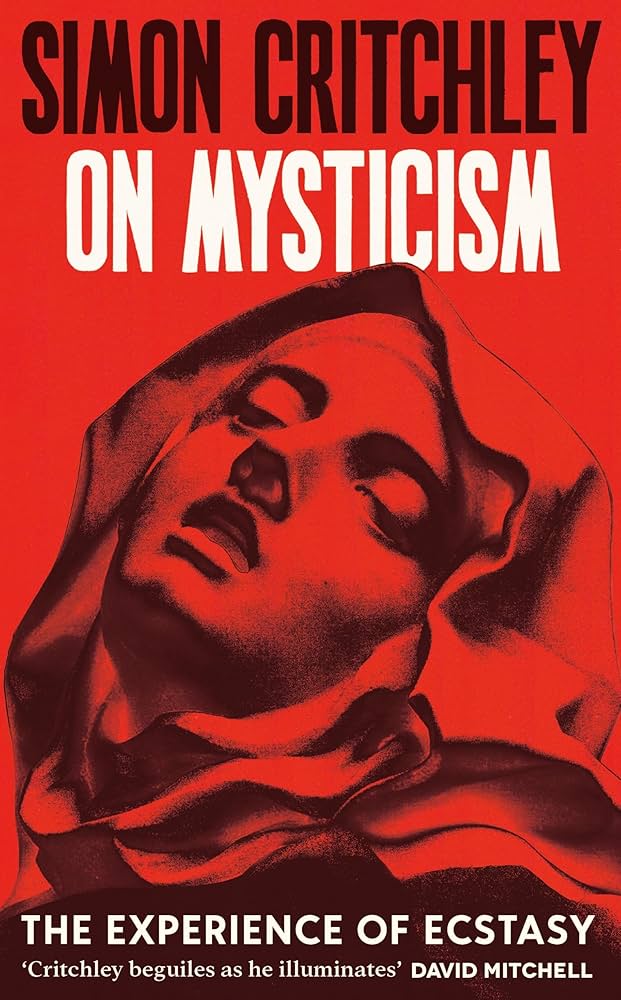
I was browsing a second hand bookshop when I came across Simon Critchley’s “On Mysticism.” On reflection, it seemed a very good place to discover a work dedicated to exploring Christian mysticism but from a context outside of church life. Critchley is a professor of philosophy who confesses to an “intense curiosity for religion” despite agreeably spending most of his life in a secular world hostile to religion. Despite the “death of God” Critchley can’t quite escape the sense that there is “something more” than the rational – the ecstatic which is of great value.
As we might expect of a professor, Critchley has done lots of reading! He draws much from Bernard McGinn’s rich and multi-volume survey of Western Christian mysticism, taking on board the way mysticism combines both theology and experience. At the same time he has a yearning for the classic work of William James that focuses on religious experience. These come together in Critchley’s focus on Julian of Norwich whose early intense experiences of God were followed by years of prayerful and theological reflection. Her shorter and longer Showings are creatively explored with an interest in how God is made visible through experience, how the divine is shown through the material. Critchley takes this further through engagement with Anne Carson, Annie Dillard and TS Eliot. How is it that the mystical experience of the ‘beyond’ results in the most personal of writings yet writings in which the human author seems most transparent and almost disappears? Critchley recognises that the theology of incarnation is key, drawing as it does on a belief in Jesus as fully human and fully divine. This transforms our view of matter and enables us to be immersed in the reality of the world whilst at the same time being immersed in the infinite reality of the divine.
The impact of this on the understanding of philosophy is important for Critchley who sees philosophers as suffering “a fantasy of return to the origin,” the original texts and ideas, whereas mysticism gives us “an ongoing, transformative history of reception” (255). Philosophy often seeks a total explanation whereas mysticism is built from an abundance of fragments of experience and writings. Critchley argues that philosophers need to stop treating mysticism with distrust and distain but rather allow themselves to be challenged by its immediacy, excess and worldliness. There seems a glimpse of the current Western cultural movement towards a reappreciation of religion.
However, for Critchley God is still dead. So what is he to do with mysticism? Translate it into forms of aesthetic experience that engage the whole of life, with something critical to communicate to the economics that dominate the world (267-285). There is a perhaps sudden shift here to the post-punk music of Julian Cope, the hearing of which have provided Critchley with mystical experience that combined with thinking brought an “idiot glee,” the “sheer mad joy at the world” that brings “releasement, detachment, enjoyment, peace, and rest” in a challenging world (285). Here is a testimony to the power and hope of mysticism. It may still find it hard to take personal steps to immersion in a known God but it helps clear the way to understanding why such steps are possible and make sense.
Bibliography
Simon Critchley, On Mysticism: The Experience of Ecstasy, Profile, 2024
Rowan Williams, The Meaning of Ecstasy, New Statesman, December 2024. This is a good review of Critchley’s book that reflects more on the nature of ecstasy and ‘decreation.’
Bernard McGinn, Foundations of Mysticism: Origins to the Fifth Century, Crossroad Publishing, 1991
 Immersed