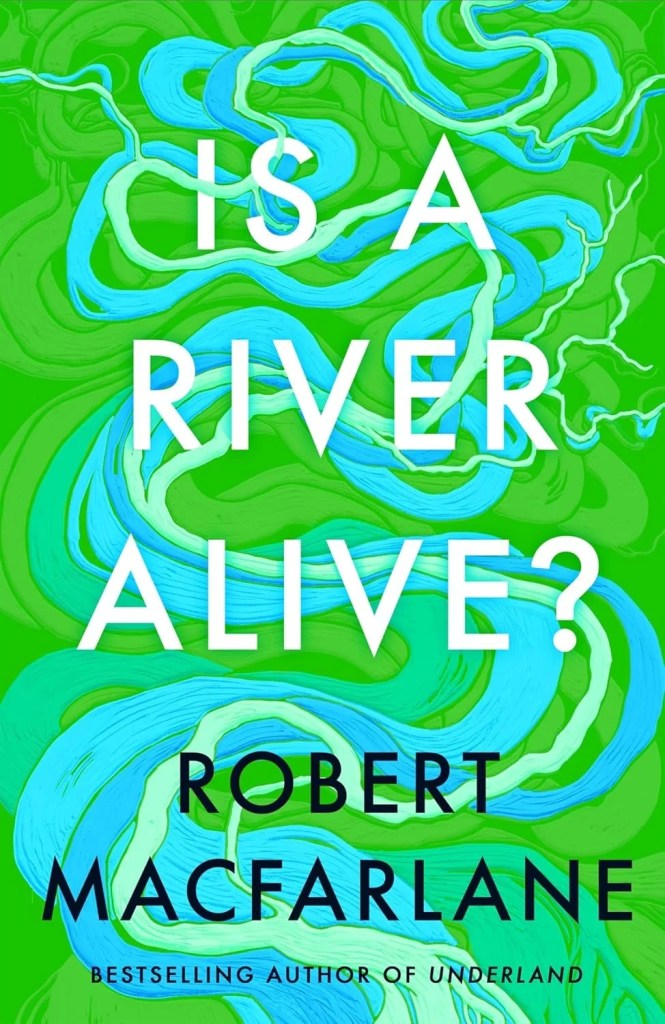
Those of us used to reading and re-reading Robert Macfarlanes writings are familiar with different streams of thought being explored even as they merge together into a journey of discovery which flows over us to produce fresh ways of seeing and living. His latest and well publicised work on rivers takes a slightly different approach that entices or disappoints depending on our expectations and background. It is as if he has pared back the tributaries to focus on the flow of three main world rivers and the obstacles they face. This has created space to expand the narratives of the others who share and inspire his journey, nurturing hope for a living world that is being systematically polluted.
What is the aim of this journey? Partly to explore the nature of “life” as it relates to rivers in conversation with the global Rights of Nature movement as it seeks to protect such life through local, legal and political initiatives. It seeks languages for animacy and is a work of pondering the questions, raising objections and ultimately finding answers in lives lived and rivers experienced. More than this, it moves from facts and science towards feelings and transformations. This is the way Macfarlane sees his own journey as a rational modernist, tempted to “live in his head,” towards a greater participation in something greater than himself, beyond and yet within the matter of a river… to be “rivered.” This is a kind of spiritual journey inspired through the animism of some of those he travels with, although there is little depth to the spiritual and religious insight despite the climax of the book being a profound experience that continues to shape Macfarlane.
The form of the book seems a refined development of that of his last book, Underland, if with fewer landscapes; the content of the book appears to revisit the sublime from his first book, Mountains of the Mind, if redirected to an experience of rivers. As usual, Macfarlane shows a profound grasp of language with the poetic description often inviting a contemplative amazement. The way he seeks to shape sentences and paragraphs in ways inspired by rivers will need repeated re-reading to fully appreciate. The gentle way he desires to face the harsh realities whilst nurturing hope is an education in sensitive learning. These come out of his amazing friendships with remarkable people, conveyed through longer narratives that at times struggle to carry the weight of thoughts and emotions placed on them. It is as if Macfarlane is stretching himself in a new direction and is still finding his way.
Rather than seeing this book through the publishers hype of greatness, I would suggest it is better read as the humble start of a fresh journey. In the flow of this journey our weaknesses are as important as our achievements. It is book particularly suitable to those struggling to immerse themselves in the world, given a cultural background of standing above it, seeing its value in primarily financial terms. It is also helpful for those seeking to go beyond the secular towards the sense of “something more” that is beyond us. We can see ourselves alongside Macfarlane being drawn into a greater sense of the life of the world and drawn outwards towards what lies beyond materialism, rationalism and capitalism that might reshape them all. The book focuses more on the first of these and the travel into what lies beyond requires much deeper resources than are provided in the vague animism mentioned. Whilst leading the way into a better understanding of the living reality of nature the book is only a first tentative step into exploring the divine Life glimpsed in landscape. There are many tributaries from the Christian spiritual tradition that can feed and nourish a deeper journey that would take this book forwards.
We can be grateful for Macfarlanes willingness to step out in new ways, stretch his impressive writing ability even further, risk admitting his need to change and grow, and find creative ways of working with others for the good of the living world in times of crisis. This book can be a means of taking forward our immersion in the world if best read alongside books by those more used to articulating the varieties and creativity of spiritual experience. I found myself longing that Macfarlane had explored more here and challenged to attempt to articulate better what is missing. May the living waters of the Spirit lead us all in risky ways of experiencing creation and developing together for the good of all.
(c) 2025 Andy Lord
Further reading: Andy Lord, Landscape, Soul & Spirit, SLG Press, 2025. A very good academic contemplative study is Douglas Christie, Blue Sapphire of the Mind, OUP. There is also the more popular but stretching approach of Beldan Lane, The Great Conversation, OUP 2019.
 Immersed