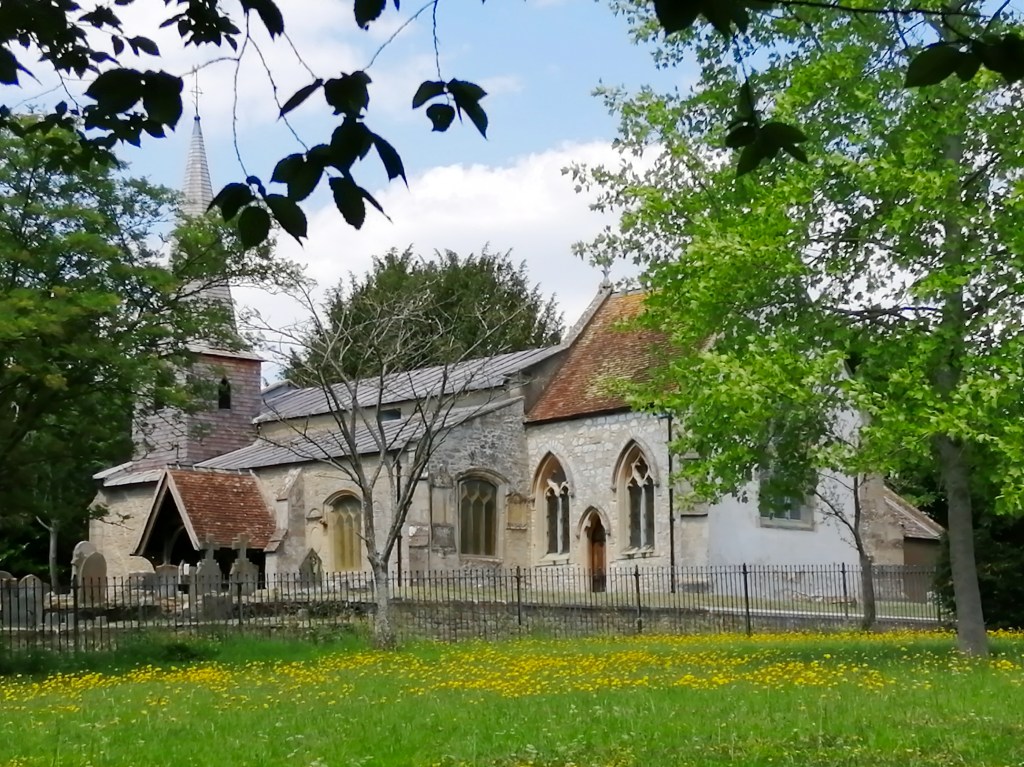
There is great pleasure in the simple five minute walk from our house to the church hall. Past the field which, in spring, sees the central tree surrounded by a circle of yellow flowers and a border of free flowing grass. Alongside the medieval church with its memories and embodied worship; the 1,000 year old yew tree that hints at life stretching further back; and the modern churchyard with chance to meet and chat. Sounds then of children on the playground and glimpses of people focused on their walk to the railway station or army barracks. I find a gentle invitation to be immersed in what is around me rather than on what is next on the todo list.
Walking requires good pauses and yesterday I found myself chatting with a neighbour about the many people who follow similar walks to myself, if often with dogs or families in tow. We reflected about how at a time of such difficult world news and the many mental health challenges people face, that walks that restore us have become more vital. The area surrounding the church represents the old village of Didcot, a small village of a few hundred people with its church and five surrounding farms. It has a deep time history that is often lost in its busy present reality of a town of 30,000 people. As it grows over the next 15 years to over 60,000 people the contrast between the town as a whole and particular walking spaces will get greater. Maybe around the church and old village there is an oasis of refreshing.
Particular places to walk, ponder and chat are key to life. Life is not just a generic term but embodied in specific landscapes. We need to be immersed in the living world, not as if we can go anywhere but within the details of the places we can go. It may be our garden; for those in a local care home it is a balcony overlooking a playground; dog walkers might embrace parks and churchyards; longer distance walkers will discover river walks and trails that go back hundreds of years. To limit ourselves to a few places and routes opens up the opportunity of really seeing them, observing the detail, noticing the changing seasons. It is so expand our understanding of life but takes discipline. We have to move, to slow down and observe, to think about what we see and to allow ourselves to simply enjoy being where we are. To stop scrolling and see how much we can see around us.
Interestingly, these disciplines are similar to those of lectio divina, the traditional form of monastic meditation. This has been focused on reading biblical and other texts – slowing down, reading and re-reading the texts, noticing what stands out, pondering the meaning and in silence simply enjoying being. This is all done within the presence of God whose love is known in joy and amidst sorrow, in words and through silence. So some speak of visio divina, seeing the divine in and through all things. This goes beyond a mindful observation of life to a hearing of God’s gentle voice that might stir our actions, and a Spirit-filled energy in which we find ourselves changing and growing. Life is not static and an immersion in oasis places through walking and pausing meditation opens us to hope for the future.
In the Gospel of John, Jesus challenges people to see truly. Most people would say that they see the living world and notice the needs of others, but I am too often like those who kept busy and speaking in ways that cover up my blindness to what is around (John 9). It is often those who live with most struggle and limits that can teach us how to see better. So I’m trying to better notice those who can help me to discern God through the living world. I’m trying to seek out the oasis places which open my eyes and heart.
(c) 2025 Andy Lord
Further reading: The Franciscan tradition has much to say in how we might be immersed in creation, see the creatively wandering book of Dan Riley & Stephen Copeland’s Franciscan Lectio. A more focused approach is that of Esther de Waal, Lost in Wonder.
 Immersed